
The next evolution of student-centered teaching.
Yoga teachers know that no two students enter the room the same way.
One arrives grounded and open.
One arrives distracted and overwhelmed.
One is carrying grief.
One is rebuilding confidence.
One is simply trying to make it through the day.
They may be in the same class. They are not having the same experience.
Most teachers already understand this. They speak to it often. They care deeply about creating spaces that feel supportive and inclusive.
What many were never taught is how to translate that awareness into the way a class is structured, paced, and delivered in real time.
Neuroscience-Informed Yoga Teaching™ offers a framework for teaching to the different states students bring into practice so more students can connect, participate, and grow.
Developed by Valerie Lucas, NIYT™ brings nervous system principles into the structure of modern yoga teaching.

Why This Matters for Yoga Teachers
Teaching becomes more meaningful when more students can truly connect to the practice in front of them.
When teachers know how to meet the room they are actually teaching, classes feel more impactful, more human, and more transformative for everyone involved.
Explore NIYT™
Neuroscience-Informed Yoga Teaching™ (NIYT™) is a framework that examines how nervous system science informs the way yoga teaching environments are structured and experienced.
Teachers can explore the work through multiple pathways:
1. The Book
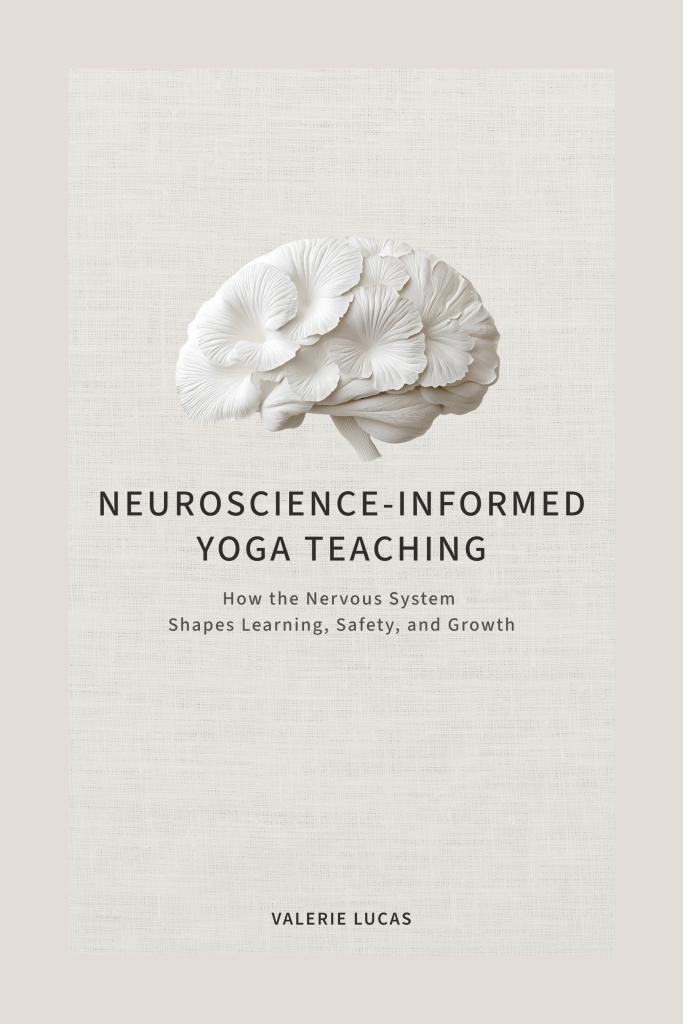
The foundational text behind Neuroscience-Informed Yoga Teaching™.
For teachers who want to better understand why teaching lands deeply in some moments and misses in others. It offers a new lens for seeing the learning experience inside the practice space and helps teachers recognize the conditions that support trust, engagement, and growth.
Ideal for yoga teachers, teacher trainers, book clubs, and training programs seeking a deeper educational lens.
Reviews
This book is a fantastic addition to the conversation around HOW we teach yoga (and movement), why it can help people, and what we can do to be more mindful of the humans in our spaces each time we enter.
— Amazon Review
As a long time teacher with multiple certificates and trainings under my belt, this book is challenging my teaching and thought process!
— Amazon Review
Well written, easy to decipher, and welcome addition to any yoga teacher’s library of resources.
— Amazon Review
2. The Professional Certificate

A self-paced, online continuing education training where understanding becomes embodied skill.
Designed for teachers ready to elevate their craft, this self-paced experience helps you turn insight into confident real-time decisions so you can lead classes that feel clearer, more connected, and more impactful.
Accredited through American Yoga Council and Yoga Alliance.
3. coming soon: The NIYT™ 200-Hour Teacher Training
A comprehensive foundational training built through the lens of neuroscience-informed teaching.
Designed to prepare future teachers not only in practice and methodology, but in how learning, attention, and nervous system state shape the teaching process itself.
For aspiring teachers, studios, and schools seeking a more modern standard of foundational yoga education.
About the Creator of NIYT™

Valerie Lucas is the creator of Neuroscience-Informed Yoga Teaching™ and founder of Yoga Teacher Academy™.
She previously served as a Senior Master Trainer and curriculum architect for YogaSix, where she helped develop and scale teacher training across more than 200 studio locations nationwide.
With more than a decade in yoga education, her work has focused on one central question:
How do we elevate the standard of teaching, not just the standard of content?
NIYT™ was created to help answer that question by bringing modern insight into how teaching is actually received in real time.
Stay in the Conversation
Follow @yogateacheracademy on Instagram for ongoing insights on neuroscience-informed yoga teaching and updates on upcoming NIYT™ trainings.

